

닫기
- About
- Committees
- Program
- Speakers
- Registration
- Abstract Submission
- Sponsor
- General Information

New AI approach maps toxic soil contamination on Czech farms
esearchers have developed a machine learning approach to map the areas where 11 potentially toxic chemicals exceed safety guidelines in Czech farmland. The model accurately predicts hazardous areas and identifies important contamination.
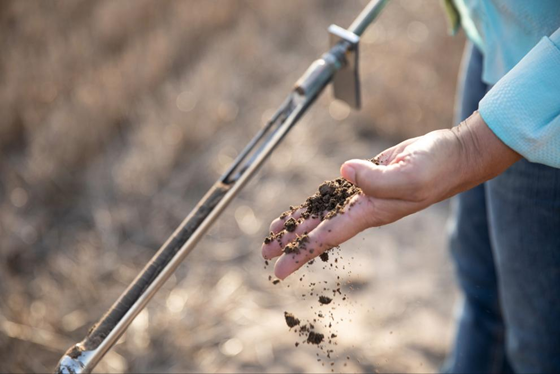
Photo by: United Soybean Board, Wikimedia
Contamination of soils by potentially toxic elements (PTEs) such as cadmium, arsenic and cobalt can negatively impact human health, agricultural production, and the environment. On a global scale, most countries have soil protection legislation that defines safety thresholds and actions for when these thresholds are exceeded. In the EU specifically, Member States may see greater responsibility to ensure that contaminated sites are adequately identified, investigated, and remediated under the EU Soil Monitoring and Resilience Directive (which enters into force in December 2025).
To minimise soil contamination risk, it is essential to identify hazardous areas where levels of PTEs are already or likely to exceed safety guidelines. Currently, insights into PTE contamination are sourced by combining measurements made at specific locations with larger spatial maps that predict PTEs – but few large-scale spatial models exist that can be used for this purpose. Machine learning (ML) algorithms have become a popular way to map the geological and chemical properties of topsoil. Such approaches are relatively easy to interpret for decision-makers, and account for the potential uncertainty of data sources.
This study develops a new ML approach to modelling soil contamination in the Czech Republic – an approach that could readily be extended to other EU countries. The researchers produce an accurate, high-resolution map to predict the extent to which topsoil PTE concentrations exceed existing Czech safety alert thresholds. The model used existing data on concentrations of eleven PTEs found in the top 20 cm of farmland soils (obtained from a national soil monitoring database in the country), and included:
For cobalt, copper, and vanadium, the study found a low (less than 2%) frequency of samples exceeding the Czech safety thresholds, whereas arsenic, cadmium, and zinc samples exceeded safety limits more often: the critical concentration (of 0.5 mg per kg of soil) was exceeded in 9% of sites for arsenic, 8% for cadmium, and 4.5% for zinc. However, overall, more than 90% of samples were within the regulatory limit.
Looking at spatial distribution, the study found that arsenic and cadmium had the most areas where the probability of exceeding the threshold was greater than 90%. This confirms that the Czech safety limits for arsenic and cadmium are conservative, say the researchers, due to the natural variation of these PTEs in Czech soils, and their potential impacts as chemicals with known human health risks.
The researchers also assessed the importance of the variables in predicting probabilities for each PTE to exceed safety thresholds, to gain insight into the usefulness of individual predictors for this type of mapping. They found that mean annual rainfall and temperature contributed significantly to the likelihood that PTEs would exceed safety thresholds. Atmospheric particulate matter (PM10) was the most important variable related to human activity for all PTEs except copper, where land cover was found to be highly influential. Increased land cover effects were also found to play an important role for cadmium, cobalt, and zinc. There was a difference in PTE contamination depending on land type – arable or grassland – suggesting a link between PTE accumulation in topsoil and agricultural practices.
By identifying how, whether, and where Czech cultivated soils exceed recommended levels of PTEs, the study's ML approach shows promise for planning, monitoring, and forecasting PTE contamination in EU soils. The researchers made their data accessible via a publicly available Czech knowledge-based platform for complex assessment of soil pollution called “SoilPAss” (Soil Pollution Assessment), on which users can use the map to view PTE probability and concentration predictions, alongside measurements of uncertainty.
Compared to previous continental assessments of soil in Europe (FOREGS, GEMAS, and LUCAS), this approach presents an analysis based on high-density data, enabling more detailed predictions about soil contamination by PTEs. The researchers note that data from ongoing efforts to monitor Czech soils in the longer term could be used to validate and fine-tune predictions made by ML models, further advancing this approach as a useful tool to support soil protection policy and action.
European Commission, 14 Jan 2026


